THE THEATRE
La Rondinellain Montefano
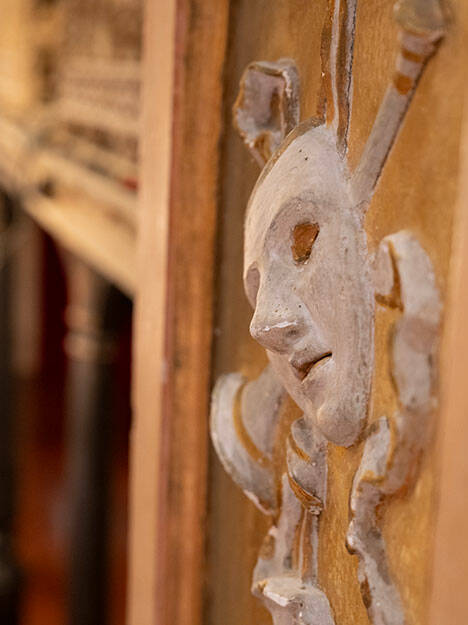
The theatre is a small architectural gem in the heart of Montefano that collects stories, visions, and passions. Spectators are welcomed into an intimate and refined space, where the beauty of details meets the power of the stage. The theatre thrives on art, memory, and future.
History
The Theatre
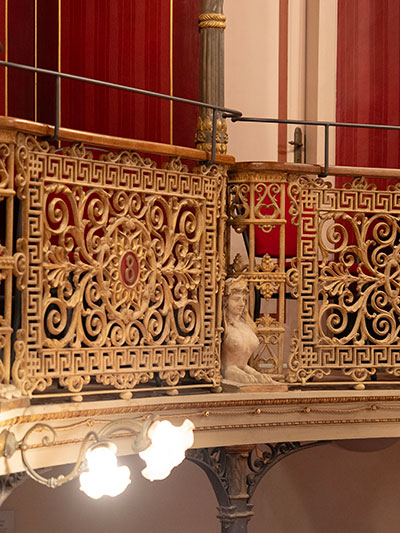
Teatro La Rondinella has its origins in the late 18th century, when Montefano decided to build a permanent theatre to respond to the growing interest for melodrama. In 1789, the construction of the stage was approved and completed in 1802. The current configuration dates back to 1887: the project was conceived by architect Luigi Daretti and carried out by engineer Virgilio Tombolini, who was at the time the technical director of Teatro La Fenice in Venice. The building anticipates the features of the pre-Art Nouveau style and stands out for the use of cast iron – the only example in the Marche region – in the balustrades of the boxes and in structural elements with lightness and elegance. The ceiling was frescoed by Domenico Bruschi, a painter from Perugia who depicted the Muses Terpsichore, Euterpe, Thalia, and Melpomene, interspersed with cherubs bearing the inscriptions “childhood”, “youth”, “manhood”, and “seniority”. In the 1980s, the theatre was declared unfit for use and abandoned until the last renovation works were completed in 2004, restoring the theatre’s original identity and role as a symbolic place for the citizens of Montefano.
The Structure
A small architectural gem
Located in the Town Hall, Teatro La Rondinella is a refined example of an intimate, cozy theatre and the only one in the Marche region with a cast iron structure. The theatre is accessed via a stone staircase with iron handrails leading to the evocative foyer known as “Sala dei Poeti” (Hall of Poets). Here, the ceiling is decorated with city’s coat of arms from the Carradori family and six medallions with portraits of Dante Alighieri, Giacomo Leopardi, Carlo Goldoni, Raffaello Sanzio, Vittorio Alfieri, and Giuseppe Verdi. The horseshoe-shaped theatre hall consists of two tiers of boxes with elegant cast iron railings, interspersed with stucco sculptures depicting the Sphinx and supported by slender columns that create a lightweight, harmonic peristyle. The ceiling features Bruschi’s octagonal canvases depicting the Muses dedicated to dance, lyric poetry, comedy, and tragedy, alternating with cherubs that represent the four ages of life. Its architecture is suspended between the Neoclassical and the pre-Art Nouveau style. The combination of rigor and ornamental grace creates a visually rich, cosy setting capable of donating an intimate and intense theatre experience to the audience.